

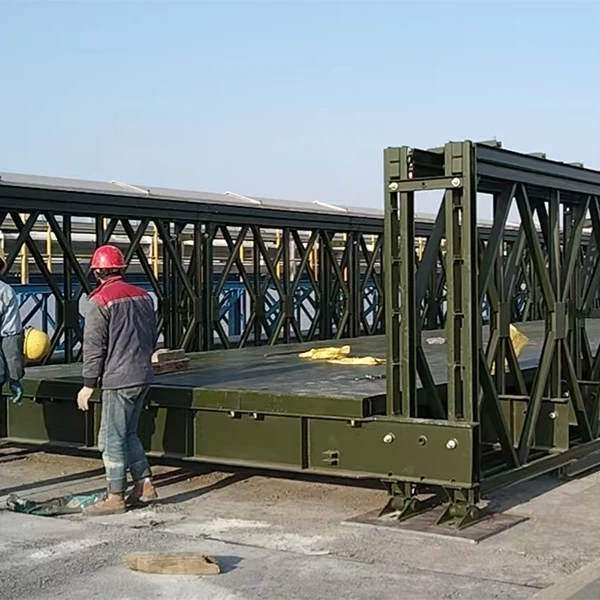
Product Introduction
The Compact-100 bailey bridge is the little, light member of the Compact family, and "100" just marks its load class in the series. We designed it around panels small enough that an ordinary truck can carry them and a small crew can stand them up with minimal crane help - which is exactly what you want at a remote site or in an emergency when heavy logistics aren't an option.
Don't let the size fool you, though. It uses the same pin-and-bolt truss logic as the bigger panel bridges, so you still get a stiff, predictable roadway for light and medium traffic. Utility companies, public-works departments, and disaster-relief teams like it because they can ship it, erect it, and pick it back up again on short notice. When the crossing only needs to carry pickups and ATVs, this is the bridge that gets out of your way.
Features
Lightweight, man-portable panels for remote or restricted sites. The compact-100 bailey bridge makes this practical.
Standard flatbed transport, with no oversized-load permits to chase.
Hand-tools-only assembly using common shear pins and bolts.
Galvanized finish for multi-year outdoor service.
Modular length and width configurable to site conditions.
Common Compact-series accessory interface across the product line.
No piling required - it sits on timber sills or steel plates.
Working Principle
This one is a simply supported lightweight truss, and the elegance is in how little it needs. A load on the deck runs through the floor beams into the two parallel longitudinal trusses. The web geometry then resolves that load as axial forces in the chords and diagonals - no mystery, just a clean pin-jointed triangle doing its job. Cross-bracing between the truss lines stops the whole thing from racking or swaying sideways.
Erection is where the Compact-100 really shines. We assemble the panels pinned together on an abutment pad, then push or roll the span across the gap on temporary rollers using hand winches or a small excavator. No crane, no piling, no drama. When it's across, it seats on bearing plates at both ends and you're done. Take-down is just the reverse - and the panels stack flat for the trip home, which is why relief crews keep coming back to it.
Applications
Typical applications for the Compact-100 Bailey bridge include: providing emergency access for personnel and light vehicles following disasters such as floods, earthquakes, or storms; establishing pedestrian or maintenance access across streams, ditches, and railway sidings; supporting remote camps, expeditions, and search-and-rescue operations; creating crossings within parks, along trails, and in resort areas; providing passage for pickup trucks and all-terrain vehicles (ATVs) on farms and ranches; and setting up temporary pedestrian walkways around construction sites and industrial facilities.
Customization
The Compact-100 Bailey Bridge offers flexible configuration to suit your site requirements: bridge panel lengths are available in 2.0-meter or 3.0-meter options, with deck widths of 2.5 meters (for pedestrians) or 3.3 meters (for a single vehicle lane), and span lengths ranging from 6 to 28 meters. With a load-bearing capacity meeting MLC 30–40 or AASHTO H10–H15 standards, it is suitable for pickup trucks, all-terrain vehicles (ATVs), and various other light vehicles. We can precisely adjust the bridge's length and width to match your specific span requirements. The structure is hot-dip galvanized in accordance with the ISO 1461 standard, ensuring durability for long-term outdoor use. It requires no piling; instead, it can be securely supported by placing it on timber dunnage or steel plates sourced locally. Handrails, ramp components, and cross-beams are included as standard. The entire system is flat-packed for transport via standard trucks, eliminating the need for oversized load permits. We also offer OEM/ODM and private-label services for relief organizations and rental companies.
Structure
The Compact-100 is a simply supported lightweight truss assembled from pin-and-bolt panels. Two parallel longitudinal trusses carry the load, with the web geometry resolving deck load into axial forces in the chords and diagonals. Transverse floor beams pick up the weight and feed it into the trusses, while cross-bracing between the truss lines stops the span from racking sideways. At each end the span seats on bearing plates that rest on timber sills or steel plates over compacted fill - no piling required. Steel grating or checker-plate deck panels form the running surface on top of the floor beams, with handrails and ramps added as standard accessories. The compact-100 bailey bridge is built for this.


