

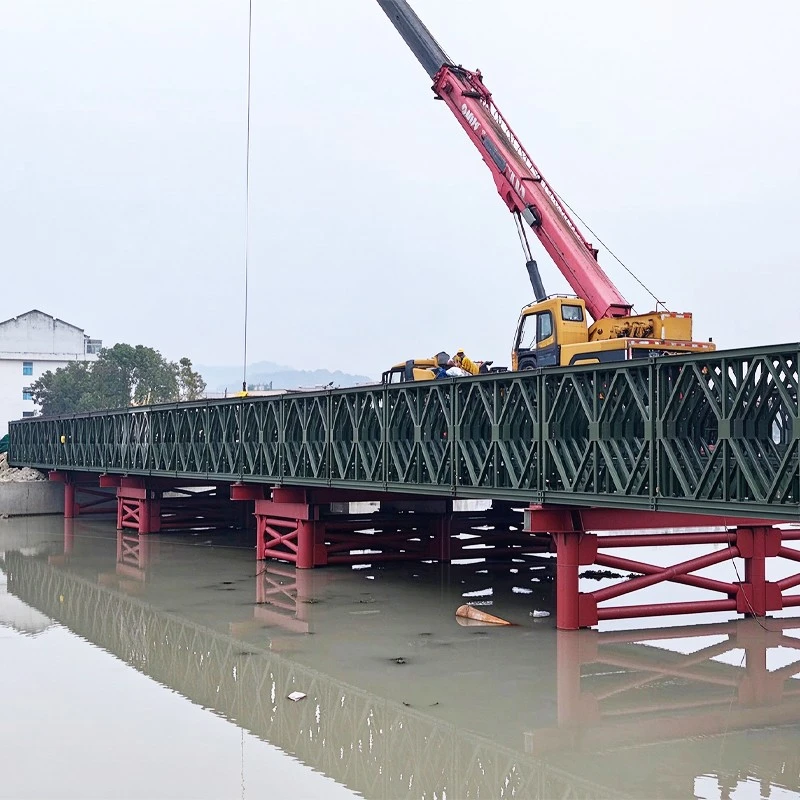
Product Introduction
A bridge expands and contracts with temperature. That movement has to go somewhere - if you hold a long steel truss rigidly at both ends, the thermal stresses will eventually push something, usually the connections or the substructure. The bailey bridge roller bearing support is what gives the bridge somewhere to move. Installed at one abutment end, it lets the completed truss undergo longitudinal thermal expansion and contraction while still transferring vertical loads to the foundation cleanly.
You pair it with a fixed bearing at the opposite end, and together they define the simply supported span: one end is locked in position longitudinally, the other end rolls. The bailey bridge roller bearing support also does double duty during erection - it is what lets you push the truss across the obstacle during incremental launching before you lower it onto its final seats. The whole assembly bolts directly to the abutment concrete or bearing shelf as a pre-assembled unit, which means no field alignment work. For any medium-to-long span bailey bridge, getting the bearings right is not optional - it is load path.
Features
Low-friction roller action allows smooth longitudinal movement under high vertical load without binding. The bailey bridge roller bearing support makes this practical.
Side guide bars prevent lateral displacement and twisting of the bridge end under traffic or wind
Pre-assembled unit bolts directly to the abutment - no field alignment or on-site machining required
Designed for both launching (during erection) and service (during thermal cycling) from day one
Machined bearing surfaces ensure uniform load distribution and long wear life between maintenance cycles
Grease-filled roller housing protects against corrosion and extends the maintenance interval significantly
Working Principle
The bailey bridge roller bearing support sits between the bottom chord of the end bailey panel and the abutment bearing shelf. Under vertical dead load (the weight of the truss itself) and live load (vehicles), the top plate bears directly on the roller or rollers, which in turn bear on the bottom plate - the bottom plate is what is bolted to the abutment. The vertical load passes through the roller in pure compression. Simple and effective. The bailey bridge roller bearing support is built for this.
The interesting part is what happens when the temperature changes. Steel expands as it warms and contracts as it cools. A 60-metre bailey bridge in a region with 30°C seasonal temperature swings can grow or shrink by 20 mm or more over the year. If that movement is blocked, the truss develops axial compression or tension forces that add directly to the bending stresses - never a good thing.
With the bailey bridge roller bearing support at one end, the top plate can slide horizontally relative to the bottom plate. The rollers underneath it change position as the bridge breathes - the friction is very low (μ typically around 0.05–0.1), so the truss can move freely without building up thermal forces. The side guide bars prevent the end of the bridge from wandering sideways while allowing the required longitudinal motion.
At the other abutment, the fixed bearing locks the bridge in position in both directions. This is the expansion reference point - the fixed end. All the thermal movement is absorbed at the roller end, and the bridge expands and contracts around that fixed point like a door swinging on its hinges.
During incremental launching, the same mechanism applies in a different context. The truss is being pushed forward from the launch point, and the rollers at the leading end of the truss reduce the friction of that push dramatically. You are essentially sliding the bridge across the obstacle with far less force than you would need if the end were dragging on a fixed bearing.
Applications
The bailey bridge roller bearing support medium-to-long span bailey bridges (30 m and above) where thermal movement accommodation is a design requirement. Incremental launching erection sequences where the bridge needs to slide smoothly across the obstacle during assembly. Bailey bridges on concrete abutments or steel trestle bents where the substructure can accommodate the bearing configuration. Permanent and semi-permanent bailey crossings in regions with significant seasonal or diurnal temperature variation. Bridges in areas with large temperature swings - continental climates, high-altitude sites, or desert environments where day-night temperature differences are extreme. And emergency bridges where rapid erection and simple bearing installation are priorities but the span still demands proper thermal movement provision.


