

Product Introduction
Flood control work has a narrow operating window. Levee raising, floodwall construction, spillway widening and channel rectification - all of it happens during the dry season, because once the rains come, the riverbanks are too wet and the water levels are too high for heavy equipment. That means the bridge you use to access the work has to go up fast and come down before the water rises. It's a seasonal problem with seasonal solutions. The steel truss bailey bridge for flood control project site is built for this.
This bridge is engineered for exactly that rhythm. It carries excavators, rock dump trucks and concrete pumps along riverbanks and across drainage channels that themselves flood seasonally. Every component is built to withstand high groundwater, seasonal flooding and the abrasive silt of a working riverbank. Once the project is complete, the same bridge can serve as a permanent inspection walkway along the levee crest - the dry-season temporary crossing that becomes a long-term asset.
Features
Seasonal erection schedule fits the dry-construction window without delaying the project. The steel truss bailey bridge for flood control project site makes this practical.
Heavy deck surfacing resists dumped rock and tracked excavators without damage.
Splash-zone coating survives wet-season immersion and silt abrasion from river water.
Wide two-way deck keeps rock and concrete convoys moving without queuing at the crossing.
Elevated deck clearance aligns with levee flood level - usable during minor high-water events.
Recoverable panels reused across multiple flood-control work fronts - one kit, many deployments.
Working Principle
The bridge works as a through-truss girder. Rock and concrete loads pass from the deck through floor beams into twin main trusses; diagonals take up shear as axial forces, chords resist bending. It's a well-proven system that performs reliably under the heavy, concentrated loads of construction equipment. The steel truss bailey bridge for flood control project site is built for this.
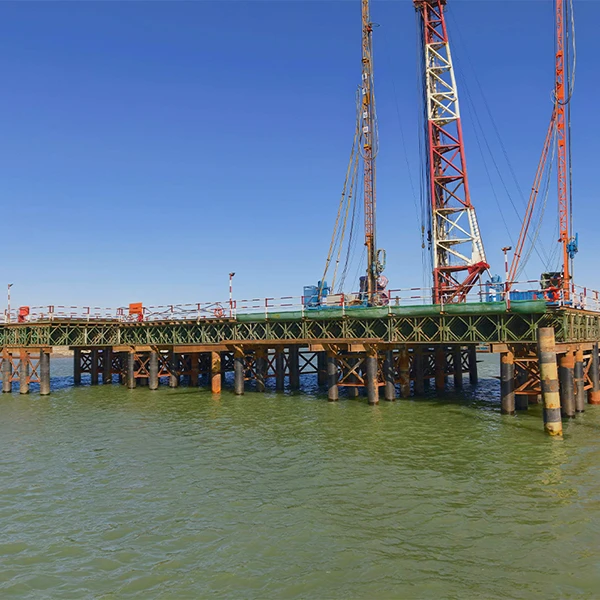
Because the riverbank ground is wet and soft, intermediate steel bents on pile clusters support the truss at regular intervals. These bents reduce the effective span of the main trusses and distribute the load into the ground. Deck elevation is set to the project's design flood level, so the bridge stays usable during minor high-water events - important when the construction schedule is tight and every dry-day counts.
Erection takes place during the dry season using the cantilever-launch method: panels go together on a working bank, a launching nose extends over the drainage channel, and a crawler crane or winch pushes the truss out. Before the wet season arrives, the bridge is inspected and struck if required to clear the floodway. All connections are pinned and bolted - no field welding, which keeps the strike and re-erection cycle fast and simple.
Applications
This product serves water-authority flood-control teams, river-management contractors, levee districts and coastal-defense agencies. Typical uses include access during levee raising and floodwall construction, crossings over drainage channels during channel rectification, access to spillway widening work sites, and temporary roads along riverbanks during embankment repair. Once the project is complete, it provides a permanent inspection walkway along the finished levee crest - a practical bonus that comes from building it right the first time. The steel truss bailey bridge for flood control project site is built for this.


