

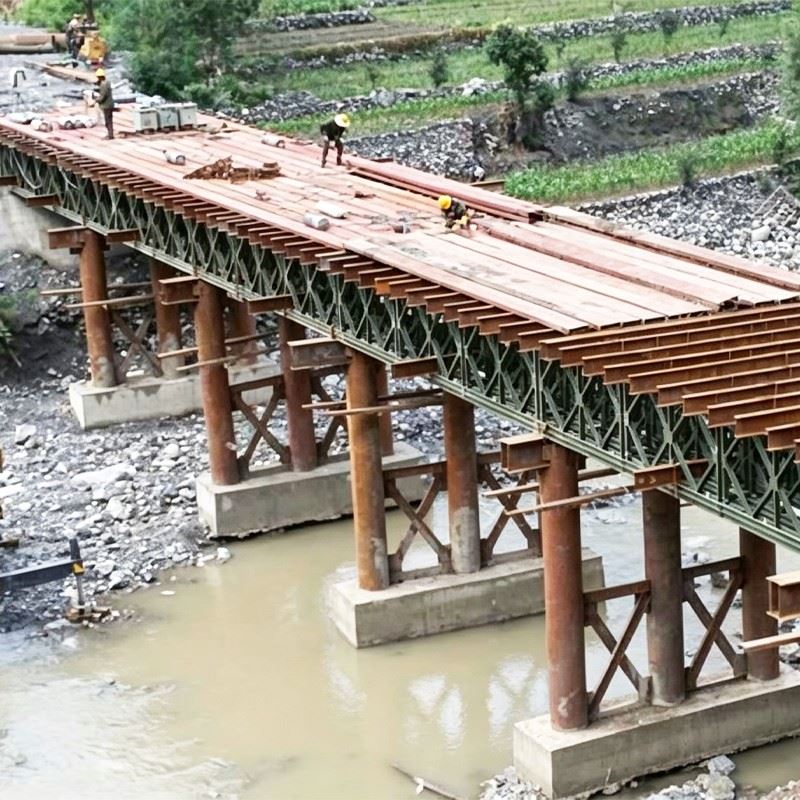
Product Introduction
Remote camps - mining camps, oil-and-gas spreads, construction laydowns, disaster-relief bases - face the same persistent problem: distributed facilities separated by ground that's too soft, too wet, or too uneven for conventional crossings. Accommodation blocks, kitchen and dining areas, storage yards and vehicle parks end up isolated from each other, and getting people and equipment between them becomes a logistical headache. The relocatable bailey bridge for short-term camp site connection is built for this.
This bridge was built for exactly that situation. It's a purpose-built temporary crossing that reconnects camp facilities over drainage ditches, seasonal streams, culverts and low-lying ground. The system is engineered for rapid deployment and equally rapid dismantling - when the camp moves to the next phase or the next site, the bridge moves with it. That means camp operators get a durable, reusable access asset rather than a structure they build once and abandon. The design prioritizes lightweight handling by small crews, low ground-bearing pressure, and resistance to the dust, mud and weather exposure that field operations deliver.
Features
Fully modular panel construction enables one-bolt-per-node assembly with hand tools only. The relocatable bailey bridge for short-term camp site connection makes this practical.
Lightweight components - individual panels typically under 270 kg - movable by two workers or a small excavator.
Reusable across multiple deployments; panel sets reconfigure to different span and width requirements.
Hot-dip galvanized finish handles multi-season outdoor exposure without a repainting program.
Low ground-bearing foundation: standard timber or steel sills on compacted fill, no deep piling needed.
Optional integrated handrails, edge curbs and anti-slip deck for mixed foot and light-vehicle use.
Working Principle
The bridge functions as a through-type Warren or Pratt truss girder built up from standardized steel panels pinned together end-to-end to form two parallel longitudinal trusses. Vehicle loads transfer from the steel deck plates and transoms into the top and bottom chords, where the truss geometry converts bending forces into predictable axial tension and compression in the web members. Cross-bracing frames and sway bracing connect the two truss lines, providing lateral stability against wind and vehicle sway. The relocatable bailey bridge for short-term camp site connection is built for this.
Erection typically follows the traditional side-construction or incremental-launch method: panels assemble on abutment staging, then are pushed or lifted into position over the gap. For shorter spans, no heavy crawler crane is required - a small excavator or a winch will do the job. Disassembly reverses the sequence, with panels stacking flat for transport in standard shipping containers.
Applications
Typical deployments include workforce and contractor camps on mining, oil-and-gas and renewable-energy projects, disaster-relief and emergency-response base camps, construction-site internal roads crossing small watercourses, temporary access between laydown yards and processing plants, pedestrian and light-vehicle crossings over drainage swales on farms, parks and event venues, and emergency bypasses when permanent culverts or small bridges are washed out or under repair. The relocatable bailey bridge for short-term camp site connection is built for this.


