

Product Introduction
Port expansion is messy. While the new berth is under construction, heavy equipment still needs to move between the existing quay, the new berth site and the landside container yard - often over deep-water basins or active wet dock areas. You can't pause the project while you figure out access, but you also can't build a permanent structure over a gap that's going to disappear once the new quay opens. That's the problem this bridge solves.
The Temporary Modular Bridge for Port Expansion Construction Work carries cement trucks, crawler cranes and container-loading equipment across the dry dock or basin gap. Every component is specified for long-term salt exposure and multi-year port construction - the marine environment is corrosive, and "temporary" in port terms can easily mean five years. The bridge also serves as temporary quay access during berth reconstruction, allowing cargo handling to continue while the old wharf is demolished and rebuilt. Once the new quay opens, the bridge is struck and the panels are recovered for the next project.
Features
Marine-grade coating system survives constant salt spray and basin humidity for multi-year deployments. The temporary modular bridge for port expansion construction work makes this practical.
Stainless fasteners prevent salt-rust failure on long-duration port construction projects.
Deep floor beams carry crawler cranes and cement trucks without deflection or fatigue.
Wide two-way deck keeps port construction traffic flowing without queuing at the crossing.
Pile-bent supports span deep water without extensive underwater work or cofferdam construction.
Fully recoverable once the new quay opens - panels return to inventory for the next project.
Working Principle
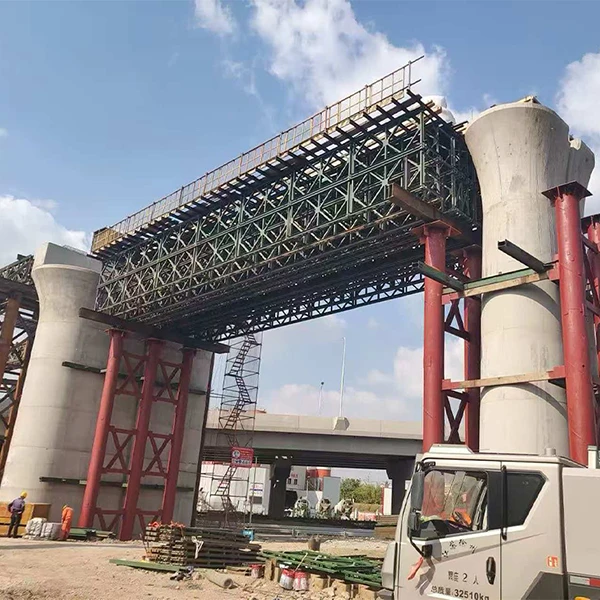
The bridge works as a through-truss girder. Construction loads pass from the deck through floor beams into twin or triple main trusses; diagonals take up shear as axial forces, chords resist bending. The triple-truss option is used when the span is long and the loads are heavy - a cement truck and a crawler crane are not light. The temporary modular bridge for port expansion construction work is built for this.
Because the crossing spans deep water, intermediate steel pile bents support the truss at regular intervals. These bents are driven by a barge-mounted vibratory hammer - no need to dewater the basin. Erection uses the cantilever-launch method from the quay edge: panels go together on the working deck, a launching nose extends over the basin, and a gantry or crawler crane pushes or lifts the truss into position. The temporary modular bridge for port expansion construction work is built for this.
Every panel connection is pinned or bolted - no field welding. This is critical in a salt-laden port atmosphere where hot work permits are difficult to obtain and weld quality is hard to guarantee. When the new quay becomes operational, the temporary bridge is struck and panels are recovered for the next port project. Nothing is left behind.
Applications
This product serves port authorities, marine construction contractors, container-terminal operators and shipyard expansion programs. Typical uses include access across dry docks during berth reconstruction, temporary quay links during wharf expansion, crossings over wet basins between new and old terminal areas, and access to offshore-loading construction sites. It also covers shipyard dry-dock access and barge-to-shore construction connections - anywhere a temporary heavy-load crossing is needed over water in a corrosive environment. The temporary modular bridge for port expansion construction work is built for this.


