

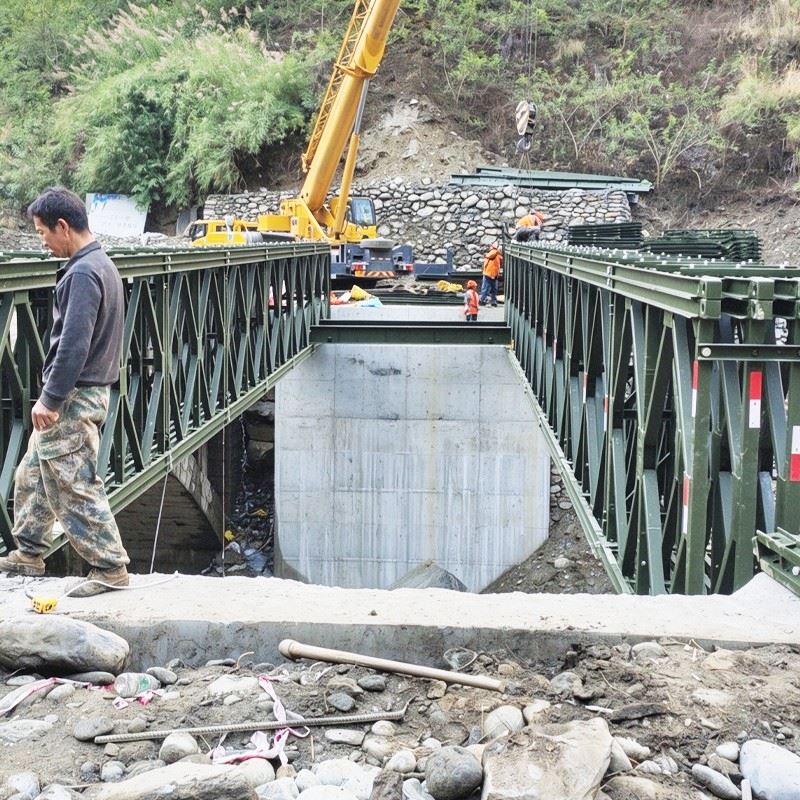
Product Introduction
After a flood washes out a road crossing, the first 72 hours decide whether a community stays cut off. The Emergency Bailey Bridge for Post-Flood Traffic Restoration is a packaged, air- and road-mobile crossing built to bring lifeline access back to villages, hospitals and supply depots before permanent repair is even possible.
We pre-kit, mark and store the components at regional emergency depots, so a response team can be on site within hours. The system spans washed-out culverts, eroded approaches and breached embankments without waiting for rock and riprap to dry out. Its low foundation demand matters most where flood debris has stripped away the normal roadbed. When the permanent bridge is rebuilt, the same kit is recovered, inspected and returned to stock for the next event.
Features
Pre-kitted emergency package with numbered panels, so assembly starts without a parts hunt. The emergency bailey bridge for post-flood traffic restoration makes this practical.
Light enough for helicopter sling load where roads are fully severed.
Low foundation requirement: simple steel sills on compacted gravel or rock mattresses.
High-visibility coating makes the crossing obvious to relief convoys and helicopters.
Tolerates residual scour and uneven approaches better than a rigid cast-in-place structure.
Rapid recovery and restock capability for repeated emergency use.
Working Principle
This is a simply supported through-truss, but the feature that sets it apart is that it goes together with no welding at all. Transverse floor beams pick the load off the deck and push it into the twin main trusses, where the diagonal web system carries it as pure tension or compression. Because the panel joints are pin-and-clip, an inexperienced rescue crew can still assemble it under time pressure. The emergency bailey bridge for post-flood traffic restoration is built for this.
The abutments are the clever bit. We use a spread footing of timber or steel sill beams on compacted ground, and if the original roadbed has scoured out, a lightweight gravel or rubble mattress spreads the reaction without heavy concrete. Launching is hand-assisted cantilever push, or a small crawler crane lifting pre-assembled panels into place. Everything relies on mechanical, fastener-only connections, so there is no curing time to wait on.
Applications
This product serves disaster-management authorities, road administrations, fire and rescue services, and humanitarian logistics agencies. It restores access after flash floods, typhoons and river-bank collapse, re-establishes ambulance and fire routes, bridges temporary washouts during monsoon season, and stands as a standby reserve at provincial or national emergency depots. Military and civil-defense units deploy it for rapid lifeline restoration as well. The emergency bailey bridge for post-flood traffic restoration is built for this.


