

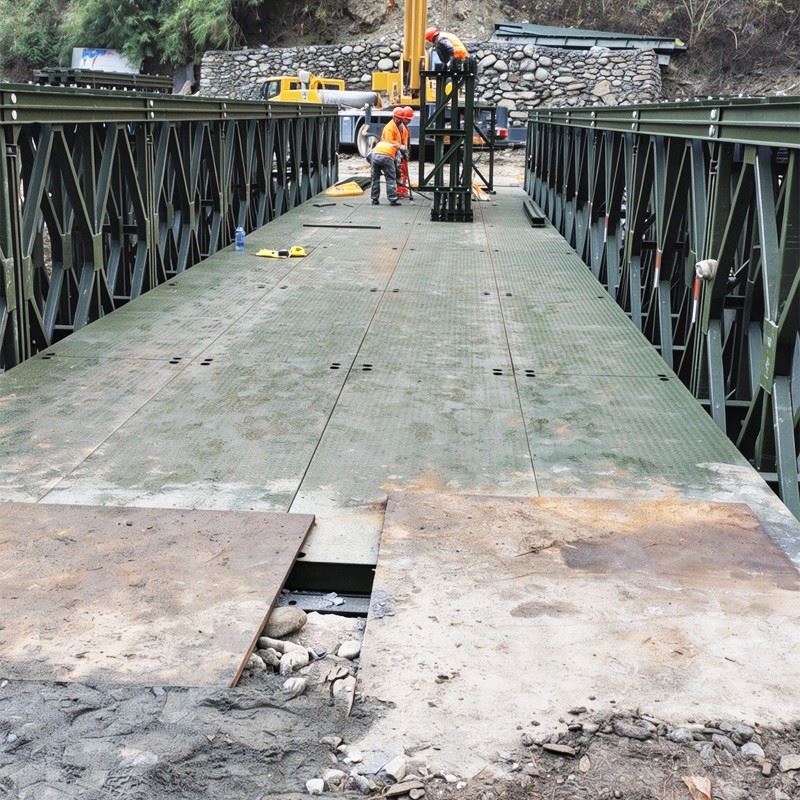
Product Introduction
Every river and ravine a long-distance pipeline crosses needs a stable route for the spread to get over it. The Bailey Bridge for Oil & Gas Pipeline Crossing Project gives a heavy-load temporary roadway that lets the construction spread move continuously along the right-of-way, without waiting on a permanent water crossing.
We engineer it for the concentrated axle loads of pipelayers and the long, slow movements of 12 m pipe strings being hauled into position. Because pipeline spreads are remote, often in marsh or desert, the kit has to be self-sufficient and repeatable, leapfrogging from one river crossing to the next as the right-of-way advances. We put the priority on high axle capacity, short erection windows and compatibility with standard spread equipment.
Features
Reinforced chords handle the high, localized track pressure of pipelayers and sidebooms. The bailey bridge for oil & gas pipeline crossing project makes this practical.
Deck surfacing resists abrasion from tracked undercarriages and dragged pipe ends.
Modular kit leapfrogs along the right-of-way from crossing to crossing.
Wide deck accommodates pipe trucks and construction equipment in opposing lanes.
Corrosion-resistant finish tolerates both desert and marsh exposure without mid-job repainting.
Spare panels are interchangeable with standard bailey inventories across regions.
Working Principle
This is a through-truss girder, and what matters for pipeline work is how it absorbs the brutal, localized loads. Floor beams take the deck loads and feed them into the twin or triple parallel trusses, while the diagonals and verticals turn deck shear and bending into axial tension and compression, so every panel earns its keep. The bailey bridge for oil & gas pipeline crossing project is built for this.
Tracked equipment is the hard case. A pipelayer's track pressure would overload a single joint, so the load spreads across multiple floor beams by design. Panels connect at the standard pin points, and we bolt reinforced chord segments on exactly where the bending moment peaks toward midspan. Erection follows the cantilever-launch method: a launching nose goes on the lead panel and the truss is pushed out over temporary steel support towers, or straight from bank to bank. Steel sills on gravel or concrete padstones take the reactions, which keeps us off deep pile foundations in remote locations.
Applications
This product serves long-distance oil, gas and product-pipeline contractors, pipeline-logistics companies and EPC project owners. Typical uses include river and wadi crossings during stringing and lowering-in, temporary access across ravines along the right-of-way, stream crossings for pipeline inspection and maintenance crews, and short-span access at pump-station and compressor-station construction sites. Water-pipeline and slurry-pipeline spreads facing similar remote terrain use it too. The bailey bridge for oil & gas pipeline crossing project is built for this.


