

Hey there! As a supplier of Bailey bridges, I've seen firsthand how these structures stack up against other types of bridges. In this blog, I'm gonna break down the ins and outs of Bailey bridges and compare them to their counterparts. So, let's dive right in!
What's a Bailey Bridge Anyway?
Bailey bridges are prefabricated, modular steel bridges that were originally developed during World War II for military use. They're known for their portability, ease of assembly, and versatility. These bridges can be quickly erected in various terrains, making them a popular choice for emergency situations, construction projects, and temporary crossings.
Comparing Bailey Bridges to Other Bridge Types
1. Beam Bridges
Beam bridges are one of the simplest and most common types of bridges. They consist of a horizontal beam supported by piers at each end. While beam bridges are relatively easy to build and cost-effective for short spans, they have limitations when it comes to longer distances.

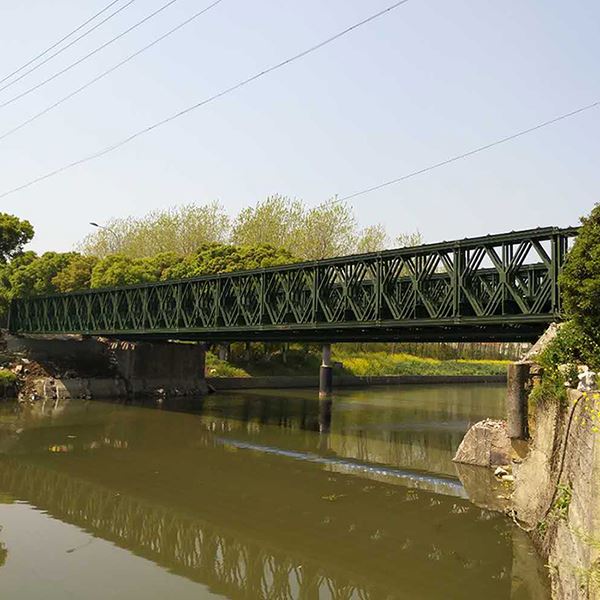
Bailey bridges, on the other hand, can be extended to cover much greater spans. Their modular design allows for easy expansion, making them suitable for a wide range of applications. For example, the Compact 200 Bailey Steel Bridge can be configured to meet different span requirements, providing a flexible solution for various projects.
2. Arch Bridges
Arch bridges are known for their elegant curved shape and ability to distribute weight evenly. They rely on the arch's structure to support the load, making them ideal for spans that require a high degree of strength and stability.
However, arch bridges can be more complex and time-consuming to build compared to Bailey bridges. They often require specialized construction techniques and materials, which can increase the cost and construction time. Bailey bridges, with their prefabricated components, can be assembled much more quickly, reducing downtime and minimizing disruption to traffic or other activities.
3. Suspension Bridges
Suspension bridges are iconic structures that use cables to support the deck. They are capable of spanning long distances and are often used for large-scale projects, such as crossing rivers or canyons.
While suspension bridges offer impressive engineering feats, they are also extremely expensive and require extensive planning and construction. Bailey bridges, on the other hand, provide a more cost-effective and practical solution for shorter spans or temporary crossings. The 321 Bailey Bridge is a popular choice for situations where a reliable and affordable bridge is needed quickly.
4. Truss Bridges
Truss bridges are made up of a framework of interconnected triangles, which provide strength and stability. They are commonly used for medium to long spans and can be designed to accommodate various loads.
Bailey bridges share some similarities with truss bridges in terms of their structural design. However, Bailey bridges offer the advantage of being prefabricated and easily transportable. This makes them a great option for projects where time and mobility are crucial. The Single Lane Bailey Steel Bridge is a versatile solution that can be quickly installed and removed as needed.
Advantages of Bailey Bridges
1. Portability
One of the biggest advantages of Bailey bridges is their portability. The modular components can be easily transported to the construction site, even in remote or hard-to-reach areas. This makes them ideal for emergency situations, such as natural disasters or military operations, where quick deployment is essential.
2. Ease of Assembly
Bailey bridges are designed to be assembled quickly and easily, even by non-experts. The prefabricated components fit together like a puzzle, reducing the need for specialized tools or equipment. This not only saves time but also minimizes the risk of errors during construction.
3. Cost-Effectiveness
Compared to other types of bridges, Bailey bridges are generally more cost-effective. Their prefabricated design reduces labor and material costs, and they can be reused multiple times, making them a sustainable choice for long-term projects.
4. Versatility
Bailey bridges can be customized to meet the specific needs of each project. They can be configured to accommodate different span lengths, load capacities, and traffic requirements. This versatility makes them suitable for a wide range of applications, from temporary crossings to permanent structures.
Disadvantages of Bailey Bridges
1. Limited Aesthetic Appeal
While Bailey bridges are functional and efficient, they may not have the same aesthetic appeal as some other types of bridges. Their industrial design may not be suitable for projects where appearance is a major consideration.
2. Lower Load Capacity for Long Spans
Although Bailey bridges can be extended to cover longer spans, their load capacity may be limited compared to some other bridge types. For very long spans or heavy loads, a different type of bridge may be more appropriate.
Conclusion
In conclusion, Bailey bridges offer a number of advantages over other types of bridges, including portability, ease of assembly, cost-effectiveness, and versatility. While they may not be suitable for every project, they are a great option for situations where quick deployment, mobility, and affordability are key factors.
If you're considering a bridge project and think a Bailey bridge might be the right choice for you, I'd love to hear from you. We have a wide range of Bailey bridge options available, including the Compact 200 Bailey Steel Bridge, 321 Bailey Bridge, and Single Lane Bailey Steel Bridge. Contact us today to discuss your project requirements and get a free quote.
References
- "Bridge Engineering Handbook" by Wei - Wen Yu
- "Structural Analysis of Bridges" by S. P. Timoshenko and D. H. Young